
Therapy
In-Person in Uttoxeter and Online
If you're feeling anxious, low, overwhelmed, or simply not yourself, it can be hard to know where to turn, or even where to begin. You might be facing something specific, or just carrying a sense that things don’t feel quite right.
Therapy offers a space to untangle what feels tender, difficult, confusing, or stuck; to explore the thoughts, emotions, and patterns that are getting in the way of how you want to feel.
You don’t need to have everything figured out to take the first step. Just a sense that something needs to change and an openness to explore what that might look and feel like for you.
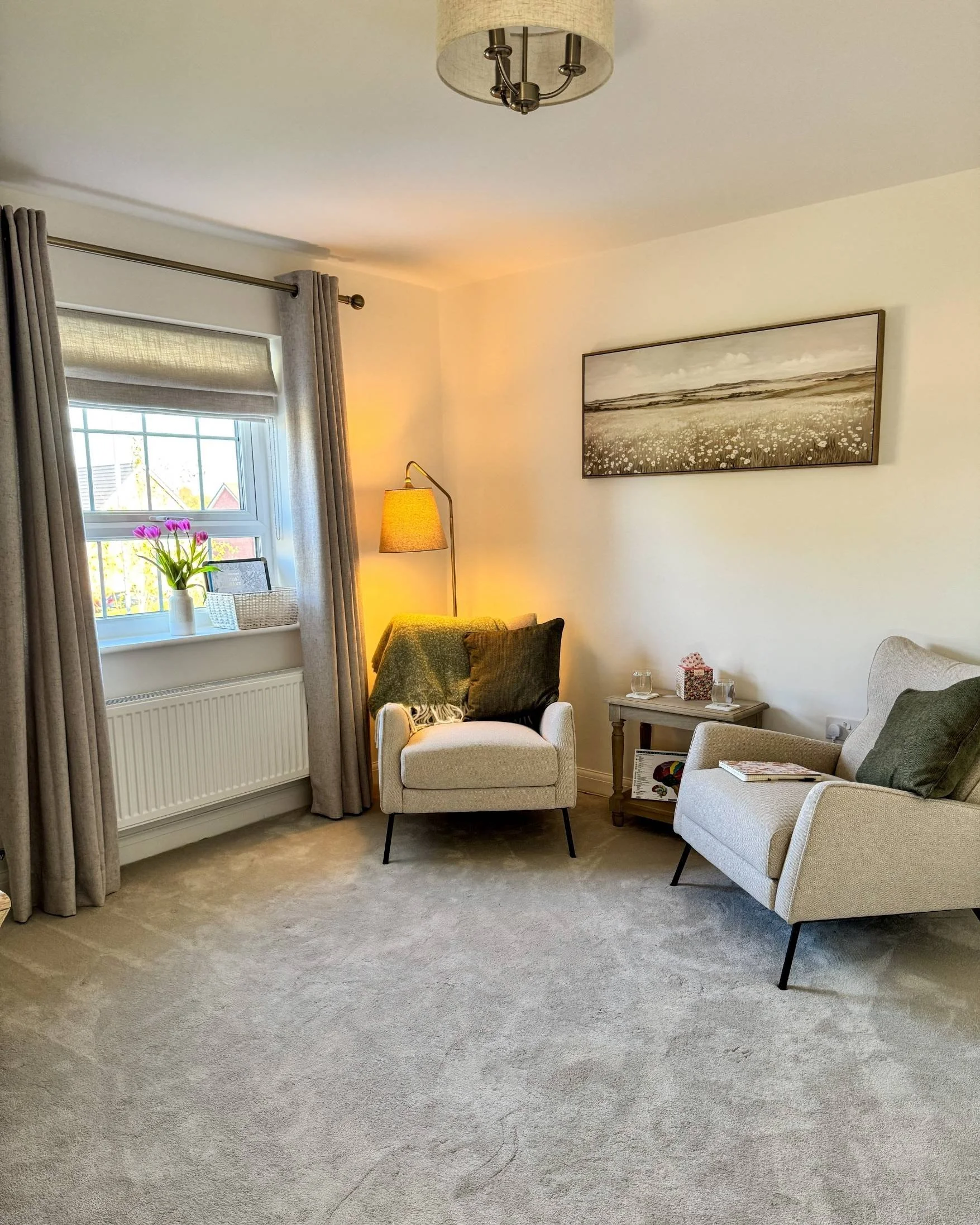
I run a welcoming, friendly private practice in, offering sessions both in-person from my calm and comfortable therapy room in Uttoxeter, and online. Whether you choose to work online or in-person, I offer a confidential and supportive space to explore what’s been feeling difficult, overwhelming, or unclear, and to begin moving toward a life that feels more manageable, meaningful, and your own. Sessions are gently structured and solution-focused, offering practical tools to support you in day-to-day life, while also addressing the deeper patterns that may be holding you back.
HOW I WORK —
My Approach to Therapy
I take an integrative, somatic, and polyvagal-informed approach to therapy, working with the body and nervous system as well as the mind and emotions to support your unique needs.
My work is rooted in Cognitive Hypnotherapy: a modern, evidence-based model that draws from a wide range of therapeutic disciplines, including neuroscience, Emotional Freedom Technique (EFT), Eye Movement Integration (EMI), Neuro-Linguistic Programming (NLP), Gestalt Therapy, and Positive Psychology. Where appropriate, I also draw from Yoga Therapy, somatic (body-based) practices, Internal Family Systems Therapy (IFS), Dialectical Behaviour Therapy (DBT), Cognitive Behavioural Therapy (CBT), and Psychotherapy — supporting a holistic, grounded path toward lasting change.
My approach is shaped not only by training and research, but also by lived experience, deep empathy, and years of walking alongside others through some of life’s most difficult and transformative moments. I don’t believe in one-size-fits-all therapy. Instead, we’ll work together at your pace to find what feels most supportive and effective for you.
What Can I Help With?
People come to therapy for many different reasons. Some arrive with something specific they want to work on, others with a more general sense that things just aren’t feeling right.
I work with a wide range of emotional and psychological challenges, including but not limited to:
Feeling stuck, lost, or out of alignment
A general sense that something needs to change
Difficulty navigating life transitions
Grief and loss
Addiction
Body image concerns
Disordered eating
Fear, phobias, or avoidance
Exam nerves
Relaxation
Anxiety and chronic worry
Panic attacks
Low mood and depression
Shame or guilt
Stress or emotional overwhelm
Trauma or unresolved past experiences
Confidence and self-esteem
Identity issues and self-doubt
Perfectionism
Inner critic and unhelpful patterns
You may not see your specific concern listed above. If you’re curious about whether this approach might be the right fit for you, please don’t hesitate to get in touch. I always aim to respond to emails within 48 hours, Monday to Friday.
Frequently Asked Questions
-
As a registered member of the NCH and QCHPA, my practice is covered by very clear guidelines and ethics meaning that I am unfortunately unable to work with anyone who has ever received a diagnosis of Epilepsy or Psychosis (Bi-Polar Disorder, Schizophrenia, Personality Disorder). I am also unable to work with you if you are already working with another therapist.
-
No, our work together is led by your pace and needs. Some people come for short-term support; others choose to journey with me over many months or years.
-
Yes, I am fully insured, have an enhanced DBS check, and am a registered member of the NCH and QCHPA.
-
Choosing the right therapist for you is important and I do not take on everyone who approaches me. If you feel ready to seek support and are willing to commit to the process of therapy then we can begin your journey. I like to offer a complementary initial consultation via phone call or Zoom so that we can get to know one another, discuss your needs and see whether we are a good fit — and most importantly, put your mind at ease.
-
Sessions can either be held in-person in Staffordshire or online via Zoom. Online therapy has been shown to be equally as effective as in-person therapy.
-
No — I will not hypnotise you. There are no swinging stopwatches, and I won’t be putting you into a trance or coaxing out your deepest secrets.
Cognitive Hypnotherapy is a modern, collaborative approach. You’ll be fully aware and in control throughout our sessions. We’ll work together to explore the patterns beneath your struggles, using gentle techniques drawn from a range of evidence-based therapies — including neuroscience, Emotional Freedom Technique (EFT), Eye Movement Integration (EMI), Neuro-Linguistic Programming (NLP), Gestalt Therapy, and Positive Psychology — to support lasting, meaningful change.
-
The word “hypnotherapy” can bring up all sorts of questions, and sometimes, a few misconceptions. Will I wave a pocket watch? Will you lose control? Will you end up doing something embarrassing?
The answer to all of these is no.
Cognitive Hypnotherapy is simply a collaborative, grounded conversation. It’s a gentle and respectful process where you remain fully aware and in control at all times. You might be invited to close your eyes and listen to my voice, but you're free to speak, pause, or open your eyes whenever you need. Many people find this creates a space of calm focus, offering a sense of ease that allows change to begin.
This approach works by gently guiding your unconscious mind toward more helpful patterns of thought, emotion, and behaviour — so you don’t have to force anything or figure it all out consciously. Often, small shifts begin to take place after just a session or two, unfolding gradually and naturally as your system begins to respond in new ways.
Cognitive Hypnotherapy is about creating lasting change in a way that honours your pace.
-
It is completely individual. You may only need two or three sessions, or you may need several sessions over a period of months. However, on average, most people need between three to six sessions. Cognitive Hypnotherapy is a form of Brief Therapy, meaning that we work to resolve your difficulties in as few sessions as possible. However, we want to make sure that the changes we create remain permanent for you. We will have a conversation about the number of sessions that may work best or you in our complimentary call before we begin your therapy, however this is completely flexible and can change if you feel you need fewer or further sessions as our work together progresses.
-
Our very first session will last about 90 minutes. Subsequent sessions will last one hour.
-
Our first session offers the opportunity for you to tell me your story, what has lead you to therapy and what you would like to work on or where/how you feel I can be of most support. I'll ask you lots of gentle questions, mostly about what things are like for you right now and, most importantly, how and who you would like to be in the future following our time together. All of the questions I ask are completely optional and you will never be required to share any information that you don’t feel comfortable talking about. We will then being our actual therapy / change-work in your second session. Although, many people find that they feel better after the first session simply just from sharing and talking about things that they've perhaps not felt ready or comfortable speaking about before.
-
Following our first session, I will create a treatment plan that is completely bespoke to you and tailored to your unique needs. Our therapy work will begin in our second session and continue in subsequent sessions until you feel that our work is done. We generally spend a bit of time at the beginning of sessions speaking about how things have been for you since we last met and whether or not you have noticed any positive shifts following the work we have done in previous sessions. I work very fluidly when it comes to what each session involves — sometimes we follow the plan that I have lovingly and carefully planned out, but most of the time we go with the flow and talk about or work through an exercise that is most supportive where you are and what you feel you need in that particular moment. We will spend a bit of time towards the end of our session speaking about a practice or something that you can do in the time before our next session which will further support your process and build on the work that we have done in sessions together.
-
Each session costs £80 and we generally have a session every one to two weeks.
-
I’ll send your invoice the day before each session. Payment is kindly requested via bank transfer, prior to your appointment.
-
To book a session, please email me at info@gracemoore.co.uk or complete the contact form here. I’ll be in touch as soon as I can — usually within 48 hours — to arrange a time that works for you.
Hear From Past Clients
-
![]()
Initially, I was hesitant about seeking therapy, however, Grace has such a calm and gentle spirit which immediately put me at ease as I preferred a holistic approach. Grace provided a safe space to express myself honestly and openly. A space where I felt seen and heard for the first time in a long time, a space of trust and confidentiality. Our sessions were tailored to my specific needs, at a pace that I felt comfortable with. Grace’s encouragement and support have impacted my life on many levels, more than I could have hoped for. Enabling me to evolve into a new version of myself, a more confident, braver, authentic version of myself. I now attend her Yoga classes, Yoga retreats, and more recently her grief circles, which I can highly recommend. Her empathy, compassion, dedication, and attention to detail are evident in everything she does. I have the deepest respect for Grace and will be forever grateful.
— Kerrie C
-
![]()
Grace was recommended to me through a friend who had also been working with her. I was apprehensive about seeking out mental health support due to being a mental health professional myself but it was honestly one of the best decisions I have ever made. Grace provided me with a safe and confidential place to share my struggles past and present, she was kind, compassionate, empathetic and professional from the very first contact and throughout our time working together. When I first started working with Grace I was stuck both personally and professionally, this is no longer the case, I have managed to progress significantly in both areas and know that having a secure place to voice my struggles and my goals was a huge part of being able to make the progress I have. I can not thank Grace enough for her help and support and highly recommend that anyone considering therapy get in touch with her.
— Georgie
-
![]()
Grace is truly incredible. Through her natural and simplistic approach to therapy, her help has truly changed my life for the better. Grace has a calming and trusting spirit which from the very beginning of working with her has encouraged me to conquer anxieties, and silence thoughts which had previously held me back for years. Through a personal and bespoke journey, each session felt structured yet relaxed and calming, allowing my mind to open up in a safe space to make changes for a better future. I cannot recommend Grace enough to anyone considering the dive into a self-discovery journey with her assistance.
— Leah H
-
![]()
I truly struggle to put into words how much my therapeutic mentoring journey with Grace has truly transformed my life, for the better. It’s beyond words. Since I began my therapy journey with Grace, I have felt seen, heard and supported - through beautifully planned yet flexible sessions, that have genuinely help me to grow as a person and through difficulties that I had been experiencing for some time. The shift in my mind and body has been a big one, yet it’s felt natural and seamless.
— Lily C
-
![]()
I absolutely love Grace’s yoga retreats. Grace hosts a beautiful retreat made special by her incredibly welcoming and kind hospitality. The balance of yoga, reflection, mindfulness and serenity is just perfect. Grace is immensely thoughtful and her retreats always include lots of special touches. The group sizes are well considered and are tailored perfectly to the various venues and the group leave the retreat genuinely inspired. Recently I attended the Winter Retreat held the week before Christmas, quite possibly the most stressful week of the year for many people but it was the ideal practice to relax, recharge, it was just perfect! I can’t wait for Grace’s next retreat. Go and you will not regret it.
— Natalie Tilsley
-
![]()
You were always such a kind, gentle and smiley little girl but also quite timid, as I remember. I am in awe of the way you are now able to lead a room full of adults in the way that you do. Your sweet and gentle nature are still clearly evident but so is your self confidence and belief in what you do. The retreat was perfectly planned and executed. You could see how much effort you had put in to organising it all and it paid off. It was such a treat to be a part of it. Time seemed to both stand still, and whizz by! It was like I had been picked up and out of my real life, and transported to another realm for a few hours! Keep it up Grace. You’re brilliant at what you do and clearly have direction.
— Jo Cleary
-
![]()
Grace’s heart warming retreat is pure bliss and highly recommend. Grace lovingly guides you through a beautifully restorative practice with gorgeous words and gentle direction. The room is so well thought out and welcoming. Gorgeous oils are passed around beforehand and there is the option to light a candle in remembrance of loved ones no longer with us. Along with homemade gingerbread and a lovely surprise at the end the evening is not to be missed. A wonderful way to honour yourself and the time of year. An evening further enhanced by Grace’s incredible playlist! This is now a must event in my calendar never to be missed.
— Amanda Baker
-
![]()
Thank you again for all the effort you put into last night's retreat. It is all noticed. It’s been wonderful and you should be proud of yourself. Thank you for for the calmness you bring into your practice. It’s not too much to say that you feel like an angel on earth.
— Cristina D
-
![]()
I can never really find the words to thank you for the difference your practices have made to my week/life!!! When I first came in October I was struggling with emotions, unresolved grief and was having some time off work. I remember finding (as I always do) such comfort and warmth during the practice and so much emotion. The Winter Retreat... what a wonderful evening filled with warmth and serenity. A wonderful yoga practice and restful meditation to nourish the soul. The little touches throughout the evening were so thoughtful, sparklers for reflection and candles for those who could not be with us… such a special evening of reflection and gratitude… I felt honoured to be part of it. Having this time and space for myself has allowed some calm to return to my life. I cannot thank you enough for that.
— Jo H
-
![]()
I found the Retreat incredible. You always have such a calm yet concise manner that your instructions could be followed with your eyes closed. It was highly relaxing yet challenging too but not so that it felt unachievable as you guided us to where our individual limits lie. The personal touch with the little bags particularly the glass bottle with the card to put inside I thought was such a lovely idea and the sparklers really thought provoking and moving. I left, as I always do after any of your retreats, calm, peaceful, thankful and happy.
— Karen Stevens
-
![]()
The yoga is restorative, the meditations nurturing and Grace suffuses warmth, kindness and gentleness. Grace is extremely intuitive and creative – her session was thoughtful, embodied peacefulness, and fostered a sense of inner calm. I cannot recommend Grace enough.
— Joanne Howe
-
![]()
Grace’s mix of insightful yoga practices fitted perfectly into the beautiful location, calming atmosphere and with such limited places, the session felt very personal.
Tina Evans
-
![]()
I had stepped out of my day-to-day life and I felt the huge relief of having a moment to pause, truly breathe, and let myself be. The whole setup was beautiful and Grace is such a caring, kind, and gentle yoga teacher.
— Jade Brazier
-
![]()
Grace is a wonderful yoga teacher. Her understanding of the body and mind and the language she uses to describe movement and postures is clear and sophisticated. She has always exceeded my expectations showing true professionalism and passion in her teaching. She will always encourage self-inquiry in an intuitive and spiritual way, encouraging us to remember yogas real purpose.
— Jan Durose
-
![]()
Without hesitation I’d encourage anyone to take part in the retreats you so skilfully deliver. It’s clear you put a huge amount of love, thought and work into your retreats. The energy radiated from all those who shared the space was just so supportive and pure. It genuinely fills me with warmth and peace. What I have learnt is that joy and happiness just won’t find us unless we stop, breath and allow it in. Last night was just that for me. I left feeling bright and at peace. I am so glad I came along, it gave me exactly what I needed. All 3 retreats I’ve joined this year have been such a tonic. I feel each one was a unique experience. I guess that’s how it works… we come along not knowing what to expect and leave with a lighter, happier heart and mind.
— Gina Brown

A Grounded Approach, Backed by Research —
Evidence-Based Practice
I’m a member of the Quest Cognitive Hypnotherapy Practitioner Association, and the results shared below reflect what I’ve witnessed in my own client work.
In 2011, the Quest Institute launched a pioneering research project. Using a team of therapists, clients with anxiety and depression were assessed using the same outcome measures currently used to assess the effectiveness of talking therapies within the NHS. The pilot study was published in the Mental Health Review Journal in 2015.
It recorded that, using 118 cases measuring the effectiveness of Cognitive Hypnotherapy for the treatment of depression and anxiety, 71% considered themselves recovered after an average of 4 sessions. This compared to an average of 42% for other approaches using the same measures (like CBT). To our knowledge, this is the only hypnotherapy approach to have been validated in this way.
For further information concerning the research project and pilot study released in the Mental Health Review Journal please visit the evidence-based therapy research page.